|
What is Brachytherapy?
Brachytherapy is increasingly seen as one of the best treatments for prostate cancer due to the ease of treatment, lower side effects, and higher success in control of prostate cancer. With a 30+ year track record of evolution and technologic improvements, it is not investigational, but very accepted as a key form of prostate cancer treatment. It is further recognized as now capable of treating the majority of men with prostate cancer, not just a small percentage as was the case 15-20 years ago.
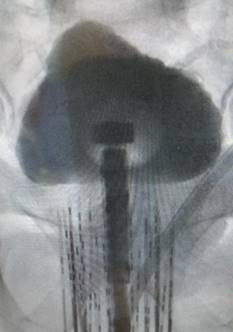 |
Fluoroscopic image of needles containing radioactive elements placed into the prostate according to the physics plan. |
Using needles passed through the skin behind the scrotum, radioactive elements (or “seeds”) are permanently placed (or implanted) directly into the prostate where they give off low-level radiation continuously for 3 to 8 months, depending on type. Using trans-rectal ultrasound guidance, these seeds can be positioned so that the radiation is distributed accurately throughout the prostate gland and surrounding margin according to a unique physics plan developed for each individual patient. Since only a small area is irradiated by each seed, relatively little radiation reaches the adjacent normal organs such as the rectum or bladder. For this reason, the total dose of radiation delivered to the prostate is 2 to 4 times that which can be delivered by external beam therapy or IMRT.
Depending upon the size of the prostate and the extent of cancer in it, brachytherapy may be performed alone, or it may be combined with androgen withdrawal (hormonal) therapy or a course of IMRT. In very rare cases, all three modes of treatment might be combined, but for most patients, brachytherapy alone is adequate.
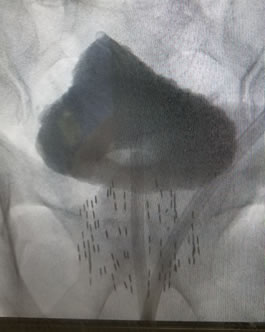 |
Implant completed in under one hour. |
Brachytherapy is an outpatient procedure and takes an hour or less when performed by an experienced team. Nearly ALL patients go home 3-4 hours later without a catheter and resume normal activities the next day or two. Since there is no incision and only a short anesthetic, treatment delivery is much better tolerated than surgery. Side effects do occur but are acceptable and generally disappear within months. Follow-up consists of PSA testing only twice a year for 4-5 years, then annually thereafter. Repeat biopsy or other invasive studies are not generally required.
Best of all, multiple centers have now reported 10-year data showing better results than with radical surgery, with some 15-year data beginning to show the same.
 Click here to download this data and learn more details about brachytherapy. Click here to download this data and learn more details about brachytherapy.
For an objective and easy-to-understand comparison of treatment results for all treatments for early prostate cancer, go the www.prostatecancerfree.org website, of the Prostate Cancer Treatment Research Foundation. This group of well-known Radiation Oncologists, Urologic Oncologists, Medical Oncologists and Pathologists reviewed, and update annually, all of the peer-reviewed published data on treatment of prostate cancer. The Disease-Free Survival (DFS) is analyzed by Risk Group (Low, Intermediate, and High). For each of the Risk Groups, DFS for patients treated with Brachytherapy alone, or combined with External Radiation and/or Androgen Blockade, is superior to any of the other treatments, including Radical Prostatectomy and External Radiation.
|